Today Is Tomorrow: A Dream About Divine Purpose | Jerry Martin’s Daybook

Telling God’s Story, One Entry at a Time

Reflections from Jerry’s Daybook and Episode 236 of God: An Autobiography, The Podcast

Today is Tomorrow

“I want you to tell My story.”

When Jerry L. Martin first heard God speak, he didn’t believe in God. He was a philosopher, a lifelong agnostic. And yet, the voice that came to him was unmistakable. 

As Jerry describes in Episode 236 of God: An Autobiography, The Podcast, God asks for something more intimate than a retelling of ancient scripture. He asks for a life lived in dialogue with the divine.

That calling continues today, not just in Jerry’s books and podcast recordings, but in the quiet insights he captures in his Daybook. 

In the entry below, Jerry recounts a dream that unexpectedly opens into spiritual insight. It’s a dream about timing, meaning, and what it might mean to live each day paying attention to God.

Today is Tomorrow

Daybook Entry: “Today Is Tomorrow”

I had the following dream. Some people were hosting a group to discuss the God book with me. As we drove to their house, we noticed some neighbors who were coming to join the meeting. To my surprise (actually, shock), when Abigail and I arrived, there was a whole crowd there, lined up in rows on lawn chairs in the front yard. They were facing a porch to be used as a speaking platform.

I had not planned to give a speech, and had nothing prepared, but I said to Abigail, “I think I had better get up there and give a talk.”
“Well, YE-AH!” she replied.

So I got up on the porch and looked at the crowd. I said, “SOMEBODY has done a great job of getting this crowd together,” and I saw a guy toward the back beam at the compliment. Chatting for a moment with someone in the front row, I said apropos of I know not what, “Today is tomorrow.” And then I said, “That wouldn’t be a bad name for a speech.” So I said to the crowd, “I did not have a speech prepared but talking with this person up front, I realized that ‘Today is tomorrow.’”

I am not usually glib but this time I launched on an elaborated discussion of the ways in which today prepares for tomorrow—enacts it in advance, you might say—and what happens tomorrow is that today’s preparation plays out. And today is, in fact, every tomorrow, and so on in that vein.

“This isn’t bad,” I thought, “though it is a lot like a Hallmark card version of a lifemanship presentation.” Then the scene faded.

Superficial or not, I was probably onto something. I have long felt that I should live every day as if the sum of my life as a whole depended on what I do now and here. My thought is not so much that what you do today sets the terms of what you are able to do tomorrow, though that is true. But my thought is more about the meaning of life, as if the highest ideal I am able to live right now casts a meaning over the whole of my life. Whether that is wisdom or just a facsimile of it, I can’t know. I occupy the thought, and can’t see over its rim. Maybe you can.

God: An Autobiography Book And Podcast

Listen to the Episode That Inspired This Post

In Episode 236, Jerry shares the moment God asked him to “tell My story,” and how we each have a part to play in that story, if we’re willing to listen.

🎧 Listen now or start from Episode 1 to hear the full journey.

Man is Important But so is the Rest of Creation

The previous prayer continued, but something I received later might be helpful here.  I had been guided to read about evolution and animal behavior.

“Why read this, Lord?”

You need to understand—to have enough concepts to understand—My history with the world, including all forms of life.  Part of the distortion in religions is they are homocentric (anthropocentric).  Man is important, but so is the rest of creation.  My history involves close interaction at every level.  Every level is part of the healing, re-creation of the world, its unfolding, fulfillment.

“Consciousness is Quite a Miracle”

Life is at first of a very low level—something like bacteria and viruses—tiny bits of life—moss and slime.

I asked, with some edge, “Lord, did You interact in a personal way with moss and slime?”

It is better if you don’t interrupt with questions.  Just listen.  Questions can come later.

Remember that I am learning all the way.  I do not know what the final product may be.  Man, as he now exists, is not the final product—only the future will tell us, including Me, that.  I feel My way, pulled forward by a felt telos or goal emergent in each step, the way an intellectual project often develops from one insight to another.  I am pulling life forward, eliciting the development of its potential, drawing it to more complex forms.

In this process, consciousness is quite a miracle, even from My point of view.  I had consciousness before, but I didn’t think of it that way.  I just was, and matter was.  It was quite startling to see other consciousness develop.  Previously (all) consciousness had been coextensive with and hence identical with Me.  It did not make sense to think of there being others as well.

Two Philosophers Wrestle With God: A Dialogue

The highly anticipated publication that extends one of the podcast’s most profound and celebrated series is now available.

This book captures the thoughtful, philosophical dialogue between Dr. Jerry L. Martin and Dr. Richard Oxenberg, as they wrestle with some of the deepest questions of existence: Who is God? What is the nature of reality? Can we understand ultimate truth?

You can purchase the paperback or E-book on HERE on Amazon


“The Common Ancestor is Eve . . .”

According to the Oxford Illustrated History of Prehistoric Europe, DNA studies “point to the conclusion that all of the present-day populations throughout the world were most probably derived from a single common ancestor, within the span of the past 200,000 years.”

“Is this the same as Adam and Eve, Lord?”

Don’t be too mythological.  That is, they were not in a Garden of Eden and so on.  But the Garden story captures with great precision the prototypical experience of human innocence, and of Divine innocence and awkwardness.  In that sense, the common ancestor is Eve, a creature of a higher development than ever before, with a new level of interaction, able to hear and respond to a higher level of whispering, and hence, over time, of much greater development.

The story of Adam and Eve portrays the first kind of experience I had with human beings.  I created them in My image.  As essentially creative force (Myself), I gave them creative force, the power of sexuality and the ability to create other human beings.  I gave them objects of beauty, in nature and in each other, and pleasure in eating, moving about, and enjoyment of each other.  I had been all alone and I enjoyed the company.

At first I imagined I could walk among humans and enjoy their company.  This required that they obey me, while not being in awe of me, and that they retain a certain innocence.  This was my first experience in discovering that humans cannot interact with God in the simple, direct way they interact with one another.  Like children not separated from their mother, at first they had little individuality or purpose.  They enjoyed the good things I had given them and did not understand the power of good and evil or the power and complexity of their own sexuality.

Nothing Existed But Me and That Itch

I was transferred to another hospital for the surgical procedure.  I was met by a technician who said his name and stuck out his hand while looking the other way.  Then I asked him to stop standing on my intravenous tube.  When it was time to go into the operating room, he snatched away my blanket with so violent a jerk that it would have ripped out the intravenous insertion if I had not by now been on high alert.

Once in the operating room, I was placed on a slab with my arms flat at my side.  Medical equipment loomed above, posing an impressive threat.  I was not supposed to move.  My nose chose that moment to itch.  It grew more and more intense.  For a time, nothing existed but me and that itch.  Then I understood I couldn’t fight it.  I just had to live with it until the procedure was over.  At that point, the itch disappeared.


“Think in a Different Way”

“Lord, I have the feeling that you want me to read and think less, and to listen more and just write down your story.”

Don’t stop thinking, but think in a different way. Don’t work so hard to figure everything out, to make it rational, to make it fit your categories. Just listen and think through the implications of what I tell you.

“But, Lord, some of what I learn from You comes from worrying over what you say.”

Sometimes yes, but often no. Sometimes your questioning just gets in the way. The main point is to open your mind, to try to understand what I am saying on its own terms, and to see ways it might be true or understandable to you.

If something doesn’t make sense to me, how can I supposed to “see ways” to make it understandable? How do you get to that vantage point?


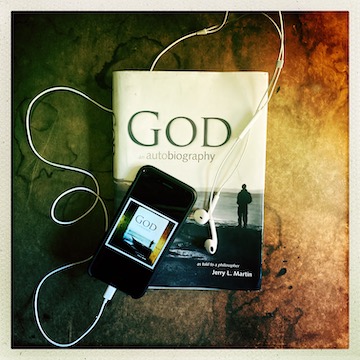
God: An Autobiography, As Told to a Philosopher – is the true story of a philosopher’s conversations with God. Dr. Jerry L. Martin, a lifelong agnostic. Dr. Martin served as head of the National Endowment for the Humanities and the University of Colorado philosophy department, is the founding chairman of the Theology Without Walls group at AAR, and editor of Theology Without Walls: The Transreligious Imperative. Dr. Martin’s work has prepared him to become a serious reporter of God’s narrative, experiences, evolution, and autobiography. In addition to scholarly publications, Dr. Martin has testified before Congress on educational policy. He has appeared on “World News Tonight,” and other television news programs.

________

Listen to this on God: An Autobiography, The Podcast– the dramatic adaptation and continuing discussion of the book God: An Autobiography, As Told To A Philosopher by Jerry L. Martin.

He was a lifelong agnostic, but one day he had an occasion to pray. To his vast surprise, God answered- in words. Being a philosopher, he had a lot of questions, and God had a lot to tell him.