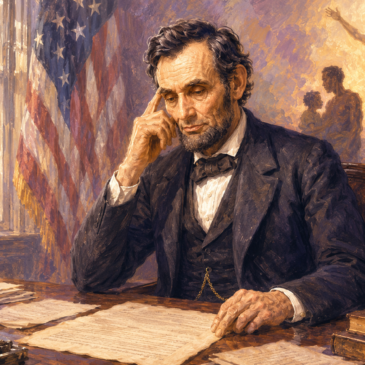
It seems that events of the Civil War transformed Lincoln’s religious side, which had previously been sufficiently skeptical that, as a candidate, he had to defend himself against the charge of being a “scoffer.”
Lincoln seemed, according to historian Shelby Foote, “not to be a praying man and he had never joined a church.” The change seemed to have been wrought by the Emancipation Proclamation. Lincoln had set out, not to abolish slavery, though he despised the institution, but to save the Union, with or without slavery, as he often explained. But the Proclamation had redefined the war, so that, “now, in this second autumn of the war, a change began to show.” On his desk, his secretary, John Hay, found the following statement, written for Lincoln’s own purposes, a “Meditation on Divine Will.” It expresses the puzzlement that, evidently, “God wills this contest, and wills that it shall not end yet.” He explained more fully to a Quaker lady who visited to praise him for the Proclamation. “If I had had my way, this war would never have been commenced.
If I had been allowed my way, this war would have been ended before this. But we find it still continues, and we must believe that he permits for some wise purpose of his own, mysterious and unknown to us …” In fact, if Lincoln had gotten his wish and war had been averted or ended quickly, the slaves would not have been emancipated, the South would not have surrendered unconditionally, and there would have been no 13th amendment, abolishing slavery.