“A Serious Question.”

A serious question.   

My life with Abigail was not simple.  She was still teaching full-time in New York, and I was working in Washington, D.C.  Whenever possible we would spend all-too-brief weekends together.

Come summer, we were spending more time together.  She needed a car.  I looked at the ads and found a nice little white used car.  The guy selling his car was the youth minister at a local church.  I started to explain that I was buying it for my girlfriend.  No, that would not sound right, and it was not true.  I was buying it for my future wife.  “I’m buying it for my fiancée.”

There had never been any doubt that I wanted to marry Abigail.  I never considered anything short of that.  But, in my methodical way, I had held off for six long months.  It was time to pop the question.

I took her to a dark, romantic Spanish restaurant in Alexandria.  I don’t know how we behaved in those days but the waiters called us the love-birds, and they put us in the “lovers’ cove” upstairs.  I had written her a little poem, a bad poem.  I can’t write poetry, but I thought the effort might soften her up.

But it was not our night.  A thunderstorm came up and, just as I was warming up to ask her, water started dripping right on our table.  Ink in the poem ran.  We scooted the table to the side.  And then I told her I loved her and would love her forever and would she be my wife?  I knew well the scene in Hollywood movies; the woman looks longingly into her paladin’s eyes and gushes, “oh yes, yes!”  Well, not the philosophical Abigail.  I asked, and waited.  And waited.  Then waited some more.  She seemed lost in deep thought.

Finally, I reminded her that I had asked a question and was still holding my breath for an answer.  In the gravest tones, she said Yes.  Why the long pause?  “It was a serious question and I thought I should give it a serious answer.”  She certainly had.

 

“For the first time, humans mirror Me, look at me eyeball to eyeball.”

God and Humans

I wondered how God interacted with these first humans.  “Did You communicate with them verbally?”

In a sense.  Early on, they do not have what can properly be called a language. 

They have sounds and gestures (and) live in a very short time-horizon—no signifiers for things distant in time or space.  I communicate in grunts and such like, in their inner ears, to give them a sense of awe and My presence.  Of course, their consciousness is still very undifferentiated.

This is not a criticism or insult.  They are quite wonderful creatures. 

Some respond in a very spiritual way.  They catch the drift and are in awe, and feel the splendor of creation and My divine presence.

“Do you give them commands?”

Yes.  Some “grunts” are warnings not to do something.  They live on the edge of subsistence and can be very cruel. 

Life is brutal and they are often brutal.  They die young.  But that does not keep them from responding spiritually.

“What does this mean for You, for Your life?”

For Me, it means the first spark of real interpersonal interaction, not just vague spiritual rapport. 

From very early, humans—protohumans—have a sense of something more, something higher.  (Their sense of) the divine is not just fear and wish-fulfillment, though there is plenty of that.  There is a real sense of relating to Me as a Person, not just as the vague spirituality of nature.

It is hard to convey in retrospect but, at this point, I do not quite know I have a personality, an individual personhood. 

Events pass through my consciousness.  I have a sense of My intelligence pervading the world, of fulfilling a universal telos.  I feel a spiritual rapport with life.  But none of that constitutes a sense of personhood, of an I standing opposite a You.  The protohumans gave Me that, or I developed it or became aware of it in relation to them.

For the first time, human beings mirror Me, look at Me eyeball to eyeball. 

“Don’t worry about doubting.”

Doubting Divine Presence

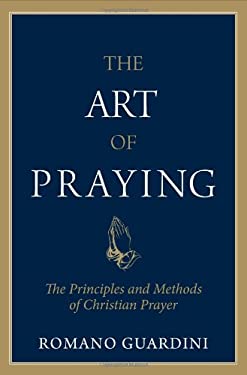
I continued to investigate the problem of discernment.  I looked for something more recent and found it in The Art of Praying: The Principles and Methods of Christian Prayer, by Romano Guardini.  According to Monsignor Guardini, “It may happen in contemplation that we have a strange experience.  We may have been reflecting on God in faith alone.  Suddenly, God is present … a wall which was there before is there no more.”  Okay, this spoke directly to my situation.

According to Guardini, there follows a period of divided reactions:  “Our intuition tells us that this is God or at any rate connected with Him.  The intimation may frighten us.  [‘Yes,’ I thought.]  We do not know whether we dare presume that this intuition is true and we are uncertain what to do.  [‘Yes, exactly.’]  However, the intuition becomes a certainty, even an absolute certainty which leaves no room for doubt.  [‘That is true also.’]”

However, Guardini says, doubts may return “when we discover that other people have no knowledge of these things.”  Yes, the problem of what will other people think.  This, he says, can lead to total unbelief.  “It may also happen that one doubts whether the whole experience had not merely been a delusion or temptation.”  Well, I never went that far.  But all is not lost, he says, if one follows this advice.  “In the face of these difficulties and doubts one should remain calm and trust in God.  One should submit to His will and pray for enlightenment.”  “Thus,” he concludes, “faith is fortified and love becomes pure.”

In short, there is a problem in believing every voice you hear.  But there is also a problem if, having sensed the divine presence, you give in to doubt.

“Lord, I am skeptical by nature and that worries me.”

Don’t worry about doubting unless it interferes with faith.  Doubting is a natural response of a thinking mind to conflicting evidence.  You may doubt—you might always doubt—but faith must transcend doubt as it transcends knowledge.

I determined to follow that path, maintaining a critical distance on my experience of God while, at the same time, yielding to divine guidance.  It is not an easy balance to strike, but it seems to be a challenge at the heart of the life of faith.  Would I be up to the challenge?