
Skip to content

  • Menu
  • Home
  • About
    • God: An Autobiography
    • Contact | Community
    • Events | News
  • Read
    • God: An Autobiography And More
    • Two Philosophers Wrestle with God: A Dialogue
    • Reviews
  • Listen
    • God: An Autobiography, The Podcast: Buzzsprout
    • Dramatic Adaptation
    • Radically Personal
    • Jerry and Abigail: An Intimate Dialogue
    • What’s Your Spiritual Story?
    • From God To Jerry To You
    • What’s On Our Mind
    • The Life Wisdom Project
    • Two Philosophers Wrestle With God
    • What’s On Your Mind
    • Interviews
  • Watch
  • What Is Your Experience with God?

Tag: divine encounter

Tell my story

“I want you to tell My story.”

January 6, 2018

Tell My story:

Abigail’s train was late. I had been waiting at Union Station for over an hour and stood to stretch my legs. Some now-forgotten images passed before my eyes, and then,

I want you to be My new Elijah.

“Your new Elijah?” I did not know whether to feel flattered, or overwhelmed, or just crazy. I protested, “Lord, I am not worthy.”

I will decide who is worthy.

I didn’t know what a new Elijah was supposed to be but I knew I did not want the job. “Lord, I don’t have faith enough.”

You have more faith than you know.

“Who is Elijah?”

He is the prophet.

“What is he to me?”

He is you.

I didn’t think that meant that I was literally a reappearance of Elijah, but still I objected, “No, Lord, this is just crazy.”

He is you.

I remembered Abraham Lincoln’s story about the man who was tarred and feathered and run out of town on a rail. “If it weren’t for the honor of the thing,” the man said, “I would rather have walked.” And I had seen the war movies, “You will have the honor of leading the assault.” Some honors aren’t worth it.

I did feel the honor. God was about to put His seal on this role for me, a role more suitable for a real Elijah. I felt a swell of pride, as I was being told this, and immediately the line went dead. Ego had broken the connection.

Abigail’s train had still not arrived. I paced back and forth, no longer seeing the other people in the station. What to think? What to feel? Finally, I forced a deep breath and, with irritation mitigated by resignation, asked, “Lord, what exactly do You want of me?”

I want you to describe the inner life of God, what it is like to be God.

The inner life of God? What it is like to be God? I didn’t know what this could possibly mean, but I forged on. “Lord, why is that important for us to know?”

Mankind sees God only from the outside and that leads to distortions in its view of God, as it would of anyone—too distant, awesome, oppressive, Other.

Even mystics are very one-sided. They experience oneness but that is not the same as empathizing with My subjective experiences.

Okay, I could see that, if God is too distant, it would be hard to relate to Him, but there was a problem. “Lord, we think of God as being so infinite and ethereal that ‘subjective experience’ doesn’t even make sense.”

Exactly—that’s one of the distortions. Although I am much more than a Person, I am a Person, a soul, like you.

You—people—cannot relate properly, constructively, to Me unless you understand that. (Take) love, for example. My love comes across as impersonal, generic, oceanic wallowing, but (in fact) it is quite specific, concrete, with feeling, with response to the particulars of your being, of your life.

I want you to tell My story.


God: An Autobiography, As Told to a Philosopher – is the true story of a philosopher’s conversations with God. Dr. Jerry L. Martin, a lifelong agnostic. Dr. Martin served as head of the National Endowment for the Humanities and the University of Colorado philosophy department, is the founding chairman of the Theology Without Walls group at AAR, and editor of Theology Without Walls: The Transreligious Imperative. Dr. Martin’s work has prepared him to become a serious reporter of God’s narrative, experiences, evolution, and autobiography. In addition to scholarly publications, Dr. Martin has testified before Congress on educational policy. He has appeared on “World News Tonight,” and other television news programs.

________

Listen to this on God: An Autobiography, The Podcast– the dramatic adaptation and continuing discussion of the book God: An Autobiography, As Told To A Philosopher by Jerry L. Martin.

He was a lifelong agnostic, but one day he had an occasion to pray. To his vast surprise, God answered- in words. Being a philosopher, he had a lot of questions, and God had a lot to tell him.


clues

I have given you some clues . . .

August 11, 2016

Clues to Creation:

I had received visions of the explosive expansions of time and space, and of divine energy rushing up through all levels of reality. Were these intimations of Creation? I was told,

The work I want you to begin involves reading and writing about My nature. Start with the Creation. I have given you some clues already. Follow up on them.

One day, in quiet reflection, I was taken deep into the Self, taken back, it seemed, to the Beginning. Here is how I described it right afterwards:

“There was a sense of things shattering, like crockery breaking, or like the shell of an egg breaking. (I think of Kabbalah and its image of Creation as divine vessels breaking.) Then there is a river, or milk, flowing out from amidst the shards. The river is clouded in mist and flows a long way down canyons of shards or rocks. Until it settles in a pool below.”

“Tranquil waters. This is when Life begins. Cool, calm but rippling waters.”

All this was taking place on a flight to California to visit my ninety-year-old father. Sitting beside me was a nine-year-old girl, traveling alone. She kept looking at me, wondering what I was up to. Ignoring her was unkind, so I stopped praying and chatted with her.

After that, I returned to my own meditations and received a stream of visual images:

A vision: the sun cracking up, solar flares that zoomed out into the reaches of space. I then saw, through the mist, an ethereal caravan of camels and their riders, coming up a valley, their long line stretching behind, down a winding road into the distance.

I followed the road back to the source.

I came upon vast winds, like a monsoon, then a world exploding—and then the vision abruptly stopped. The caravan seemed to represent the long course of human history, traced backward, all the way to the beginning, and then nothing.

I had received hints about the moment of Creation. Then, one day, He told me more. This is where God’s story really begins.

______

Listen to this on God: An Autobiography, The Podcast– the dramatic adaptation and continuing discussion of the book God: An Autobiography, As Told To A Philosopher by Jerry L. Martin.

Egyptian God control God, mistake of man

“It’s a mistake to try to control God . . .”

July 26, 2016

Trying to control God:

My first impressions of the ancient Egyptians were formed in Sunday School, put to music by gospels such as “Go Down Moses,” and brought to the silver screen by Cecil B. DeMille.  It was not a pretty picture—false gods, harsh rulers, fake magicians, and slave-drivers wielding the lash.

Egypt was on the wrong side of everything.

But now I was told that God was sending divine messages to every culture.  So I had to look at the land of the pharaohs through different eyes, Egyptian eyes.

Written in hieroglyphs that were already old when Sumerian cuneiform was young, the Pyramid texts date back almost five thousand years.

Chiseled into the walls of the dark corridors beneath these monumental tombs, these texts provide the deceased Pharaoh. Keys to a successful afterlife. How to overcome each obstacle on the way to the divine realm… What words to speak to the guardians who block the way.  One strategy was to enter the cyclical course of the cosmos and accompany the sun god in the baroque that transverses the sky each day.

The deceased king went so far, according to one inscription. As to kick the sun god overboard to make room for himself in the divine baroque.

The complex mythology of the Egyptians far surpassed the simple piety of preliterate polytheism.  But, however complex, these greedy efforts to compel or trick the divine powers seem spiritually retrograde compared to the sensitive cave paintings and the humble peasant honoring a stream with a pile of stones.

“Isn’t that right, Lord?”

Yes, it is a fundamental mistake of man to try to control God rather than the other way around. 

Do not exaggerate it.  It is no different from (no worse than) trying to bribe the king’s mistress or learn the password that goes you through the palace gates, but it is not high spirituality, and in fact is not really a kind of spirituality at all.

Egyptian God control God, mistake of man

“It is a mistake of man to try to control God rather than the other way around.”

July 26, 2015

Mistake of Man-

My first impressions of the ancient Egyptians were formed in Sunday School, put to music by gospels such as “Go Down Moses,” and brought to the silver screen by Cecil B. DeMille.

It was not a pretty picture—false gods, harsh rulers, fake magicians, and slave-drivers wielding the lash.

Egypt was on the wrong side of everything.

But now I was told that God was sending divine messages to every culture.

So I had to look at the land of the pharaohs through different eyes, Egyptian eyes.

Written in hieroglyphs that were already old when Sumerian cuneiform was young, the Pyramid texts date back almost five thousand years.  Chiseled into the walls of the dark corridors beneath these monumental tombs, these texts provide the deceased Pharaoh with the keys to a successful afterlife:  how to overcome each obstacle on the way to the divine realm and what words to speak to the guardians who block the way.

One strategy was to enter the cyclical course of the cosmos. And accompany the sun god in the barque that transverses the sky each day.

The deceased king went so far, according to one inscription, as to kick the sun god overboard to make room for himself in the divine barque.

The complex mythology of the Egyptians far surpassed the simple piety of preliterate polytheism.

But, however complex, these greedy efforts to compel or trick the divine powers seem spiritually retrograde compared to the sensitive cave paintings and the humble peasant honoring a stream with a pile of stones.

“Isn’t that right, Lord?”

Yes, it is a fundamental mistake of man to try to control God rather than the other way around.  Do not exaggerate it.  It is no different from (no worse than) trying to bribe the king’s mistress. Or learn the password that goes you through the palace gates. But it is not high spirituality, and in fact is not really a kind of spirituality at all.

________

Listen to this on God: An Autobiography, The Podcast– the dramatic adaptation and continuing discussion of the book God: An Autobiography, As Told To A Philosopher by Jerry L. Martin.

He was a lifelong agnostic, but one day he had an occasion to pray. To his vast surprise, God answered- in words. Being a philosopher, he had a lot of questions, and God had a lot to tell him.
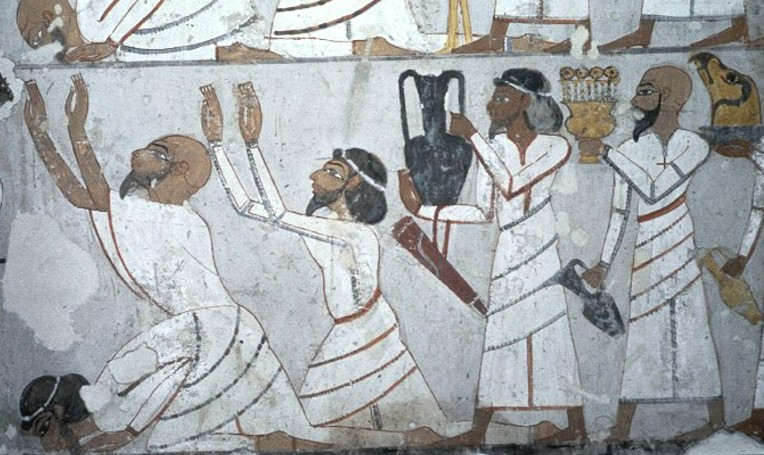
 

Akhenaten, spiritual vision

“He tried to impose a spiritual vision.”

February 22, 2015

Spiritual Vision-

Akhenaten may have been the first monotheist.

We have his own words, carved in stone.  The young pharaoh reports having been divinely guided to the exact place the Creator had manifested himself at the beginning of the world.  It was a plain near the Nile, bounded by hills except on the east, a great amphitheater facing the morning sun.

Akhenaten’s vision was not of many gods, but of one god—a god, with no female consort, who created himself anew each day.

He was called the Aten, or Father Aten, and symbolized by the solar disk.  “Thou didst fashion the earth according to thy desire when thou wast alone … thou appointest every man to his place and satisfiest his needs.  Everyone receives his sustenance and his days are numbered.”

The Aten is the source of life itself.

“Thou it is who causest women to conceive and makest seed into man, who gives life to the child in the womb of its mother, who comfortest him so that he cries not therein, nurse that thou art, even in the womb, who givest breath to quicken all that he hath made.”  The god created the great life-giving Nile for Egypt, but he is a universal god who has placed “a Nile in heaven,” the source of rain, as a “gift to foreigners and to beasts of their lands.”

The Aten was symbolized by a figure of the sun with rays reaching out in all directions.

At the end of each ray is an open hand reaching out in loving kindness, as if to touch with life, and to give and to receive gifts.  “Thou art remote yet thy rays are upon the earth,” writes Akhenaten.  “Thou are in the sight of men, yet thy ways are not known.”  The Aten can also be very near, at least to his spokesperson.  “Thou art in my heart.”

It was a breathtaking vision and it shook Egypt from its moorings.

The other gods, he proclaimed, were not gods but idols.  Upon his orders, their images were destroyed.  In their place was put the austere hieroglyph for the Aten, increasingly understood not as the sun or even the sun-god, but as a distant and unrecognizable divinity.

This was gross impiety to most Egyptians, an insult to the gods.

Akhenaten’s “monotheistic zeal offended their reverence for the phenomena [through which the gods made themselves present] and the tolerant wisdom with which they had done justice to the many-sidedness of reality,” explains Henri Frankfort.

The result was perhaps predictable.

Upon the pharaoh’s death, priests and people alike turned against this strange and remote monotheism.  The old statues, temples, and forms of worship were restored.  Ahkenaten’s vision was a stunning venture in spiritual understanding but, in the end, came to nothing.

“Lord, what is the meaning of Akhenaten?”

Akhenaten was an extraordinary recipient of My inspiration (and of My) presence. 

He was, as all are, bound by his culture and the symbols he had available.  But he got the main message—that, in a sense, I am One, that I am not to be equated with the sun or any other natural phenomena, that other gods are lesser or “mere” manifestations of Me or, in a sense, non-existent compared to Me.  The problem he ran into is that he was alone in his receptivity.  Others were not prepared, were not open.  The most spiritual Egyptians of his era were attuned to the old religion and could not jump the traces.  It would have seemed impious to them.

“What was the difference between them and the people of Israel?”

The people of Israel were a people. 

They—the mass of them—had an intuitive understanding of a Covenant.  Remember that the mass of ancient Jews were not faithful, or (they were) faithful only periodically.  But they all lived under the Covenant and understood that they so lived.  Akhenaten tried to impose a spiritual vision from above, through imperial authority and example.  Even his wife did not understand the vision; she followed it out of her great love for her husband.

________

Listen to this on God: An Autobiography, The Podcast– the dramatic adaptation and continuing discussion of the book God: An Autobiography, As Told To A Philosopher by Jerry L. Martin.

He was a lifelong agnostic, but one day he had an occasion to pray. To his vast surprise, God answered- in words. Being a philosopher, he had a lot of questions, and God had a lot to tell him.

cave paintings, beauty also becomes possible

“Beauty also becomes possible . . .”

August 10, 2014

Beauty also becomes possible, as you see in prehistoric cave paintings. 

Creatures from a very low level enjoy and appreciate sensory stimulation.  In that sense they find a scene (though not quite a “scene” for them yet) “beautiful.”  But true appreciation of beauty is seeing an ideal form in something material.  What they are drawing on cave walls are ideal bulls.

“I have seen those drawings.  They are amazing.”

Study the cave paintings and other artifacts. 

They respond to, reflect, how I was presenting Myself to them.  You will be able to see or infer what My experience was like, what I was trying to do.

________

God: An Autobiography, As Told to a Philosopher – is the true story of a philosopher’s conversations with God. Dr. Jerry L. Martin, a lifelong agnostic. Dr. Martin served as head of the National Endowment for the Humanities and the University of Colorado philosophy department, is the founding chairman of the Theology Without Walls group at AAR, and editor of Theology Without Walls: The Transreligious Imperative. Dr. Martin’s work has prepared him to become a serious reporter of God’s narrative, experiences, evolution, autobiography and sparks of wisdom. In addition to scholarly publications, Dr. Martin has testified before Congress on educational policy, appeared on “World News Tonight,” and other television news programs

________

Listen to this on God: An Autobiography, The Podcast– the dramatic adaptation and continuing discussion of the book God: An Autobiography, As Told To A Philosopher by Jerry L. Martin.

He was a lifelong agnostic, but one day he had an occasion to pray. To his vast surprise, God answered- in words. Being a philosopher, he had a lot of questions, and God had a lot to tell him.


Posts navigation
Newer posts →
Your journey starts here.
BUY THE BOOK

Copyright 2016 - God: An Autobiography by Jerry L. Martin. - All Rights Reserved. - Content may not be used without permission of the author.

Your journey starts here.
Are you ready to go deeper?
Want a FREE preview of the book?
YES!
I can't wait to read more!
Thanks,
maybe later.
Send me the FREE eBook preview!
Your journey starts here.