“Do you think I could come to the ancient Jews in the same way I came to the seventh century Chinese? to Americans today?”

How God Comes To Different People:

I had been told that culture is a factor in divine revelations.

“Lord, why is culture so important?”

That’s like saying, why language?  If I am going to communicate with people, they need a language.  For the same reason, they need a culture.

“They need a culture, but why such a variety of cultures?”

There are many ways of realizing (actualizing) the human story.  Culture enables lives of different (types of) significance (meaning).

“But why, in terms of Your story?”

I need to come to people in all their particularity, not to mankind-as-such.  The Chinese is one way of being.  The primitive is one way of being.  I come to each in its own terms.  Each enables Me to show a different side of Myself.

Do you think I could come to the ancient Jews in the same way I came to the seventh century Chinese? to Americans today? to you?

Learn more about how God comes to different people.

Mind is Like a Fluid …

There is a parallel question about language.  How is it that a word relates to or refers to a particular object?  The word is itself an object, a vocalized sound or a mark on a page.  What connects the word “bell” to the bell?  Sometimes it is said that one “points” to the other, but that is a figure of speech.  As the twentieth-century philosopher Ludwig Wittgenstein observes, the same question arises with pointing.  When you stretch out your finger, why does it direct attention to an object across the room, rather than to itself?

Follow along, and open your mind.  Mind is like a fluid in which human beings and the natural world exist.  By participating in the fluid, minds can understand.  Think of the problem of intentionality.  How is reference possible?  How can essences be grasped?  How can objects be seen?  There must be an interaction, and it is not only causal-physical.  How could it be?  Mind, understanding, is not just physical.  It is a conscious, fluid medium.

“Is it somewhat physical?”

Those categories are not helpful here, but it exerts physical force, has physical consequences.


An Odd Dream About Criticism and Self-Restraint

I had an odd dream. Some guy called me, saying that I was a terrible person in this way and that way and another way. I didn’t think I was that bad but, in the dream, I didn’t defend myself “because I didn’t want to dampen his enthusiasm.” Well, go figure!

“Consciousness is Quite a Miracle”

Life is at first of a very low level—something like bacteria and viruses—tiny bits of life—moss and slime.

I asked, with some edge, “Lord, did You interact in a personal way with moss and slime?”

It is better if you don’t interrupt with questions.  Just listen.  Questions can come later.

Remember that I am learning all the way.  I do not know what the final product may be.  Man, as he now exists, is not the final product—only the future will tell us, including Me, that.  I feel My way, pulled forward by a felt telos or goal emergent in each step, the way an intellectual project often develops from one insight to another.  I am pulling life forward, eliciting the development of its potential, drawing it to more complex forms.

In this process, consciousness is quite a miracle, even from My point of view.  I had consciousness before, but I didn’t think of it that way.  I just was, and matter was.  It was quite startling to see other consciousness develop.  Previously (all) consciousness had been coextensive with and hence identical with Me.  It did not make sense to think of there being others as well.

“Think in a Different Way”

“Lord, I have the feeling that you want me to read and think less, and to listen more and just write down your story.”

Don’t stop thinking, but think in a different way. Don’t work so hard to figure everything out, to make it rational, to make it fit your categories. Just listen and think through the implications of what I tell you.

“But, Lord, some of what I learn from You comes from worrying over what you say.”

Sometimes yes, but often no. Sometimes your questioning just gets in the way. The main point is to open your mind, to try to understand what I am saying on its own terms, and to see ways it might be true or understandable to you.

If something doesn’t make sense to me, how can I supposed to “see ways” to make it understandable? How do you get to that vantage point?


God: An Autobiography, As Told to a Philosopher – is the true story of a philosopher’s conversations with God. Dr. Jerry L. Martin, a lifelong agnostic. Dr. Martin served as head of the National Endowment for the Humanities and the University of Colorado philosophy department, is the founding chairman of the Theology Without Walls group at AAR, and editor of Theology Without Walls: The Transreligious Imperative. Dr. Martin’s work has prepared him to become a serious reporter of God’s narrative, experiences, evolution, and autobiography. In addition to scholarly publications, Dr. Martin has testified before Congress on educational policy. He has appeared on “World News Tonight,” and other television news programs.

________

Listen to this on God: An Autobiography, The Podcast– the dramatic adaptation and continuing discussion of the book God: An Autobiography, As Told To A Philosopher by Jerry L. Martin.

He was a lifelong agnostic, but one day he had an occasion to pray. To his vast surprise, God answered- in words. Being a philosopher, he had a lot of questions, and God had a lot to tell him.


“The First Glimmer is Found in the Lowest Molecules.”

Consciousness developed very slowly.  The first glimmer is found in the lowest molecules, in their ability to interact with, to respond to, their environment.  Whitehead and Teilhard are on the right track in this regard.  (Leibniz is not.)

I had to look again at these thinkers to see what God was getting at.  Rejecting the mind-nature dualism, the twentieth-century philosopher-mathematician Alfred North Whitehead held that, even at the micro level, every event is a pulse of existence, feeling and responding to its environment.  These “prehensions” are not so much states as vectors, arrows pointing to connections with the surrounding world.  The Jesuit scientist-philosopher Pierre Teilhard de Chardin spoke of the “within” of things, their interiority, which “appears at the heart of beings”:  “Co-extensive with their Without, there is a Within to things.”  In every part of the universe, “the exterior world must inevitably be lined at every point with an interior one.”  By contrast, the seventeenth century philosopher-mathematician G.W. Leibniz believed that everything in the universe was made of elementary particles that were not matter or energy, but minds, centers of consciousness, each of which internally mirrors all the others.  In short, Whitehead and Teilhard believed that physical (or psycho-physical) nature has levels of awareness—and they were on the right track—whereas Leibniz held that there is no physical nature other than points of consciousness.

As God went on, He sounded a lot like Teilhard.

What happens is that reactions have an internal dimension—responding to the environment, the molecule begins rearranging its internal parts and configurations and processes.  This is the beginning of interiority.  Ultimately, interiority involves the second-order process of monitoring and directing inner processes.  But, even at the beginning, prior to the emergence of second-order processes, there is an emerging consciousness.  To be conscious is not the same as and does not require self-consciousness.  It can be very dim and limited and still be consciousness, because something new and remarkable has arisen—the pre-sentient and then sentient awareness of the environment.  Don’t worry at this point about what is meant by “pre-sentient” awareness.  Your understanding is necessarily anthropocentric, using human consciousness as the standard by which to understand all forms of consciousness.

“The Personal is essentially interpersonal.”

God was telling me about His interaction with the earliest animals, long before homo sapiens.

 It is mainly an instinctual unselfconscious rapport that we have.  But (I feel) a great excitement at the process of life and evolution itself.

“Why isn’t that enough?”

In a sense it is.  Animals do have uniqueness.  Each animal is distinct, has its own soul.  But they lack self-awareness, and that is true even of cats and dogs and apes.  You can interact with them but there is no second-order reflection, hence a very truncated sense of time—just a sense of temporal motion, of passage from an immediate moment-just-passed to a next moment anticipated.  And even that cannot be thought about, represented symbolically or made available to self-consciousness.

So I cannot develop solely through interacting with them.  It is static, inert.  We just are together.  I could not become a Person without there being other persons.  The personal is essentially interpersonal.  Like a child who first lives in an undifferentiated world, in which other people are merely contents of his or her own oceanic flow of consciousness, I needed to separate Myself from other persons.  And so I created mankind.

“The Great Apes Are Wonderful Creatures . . . So Close But Yet So Far.”


“And so, Lord, You call forth the first human beings?”

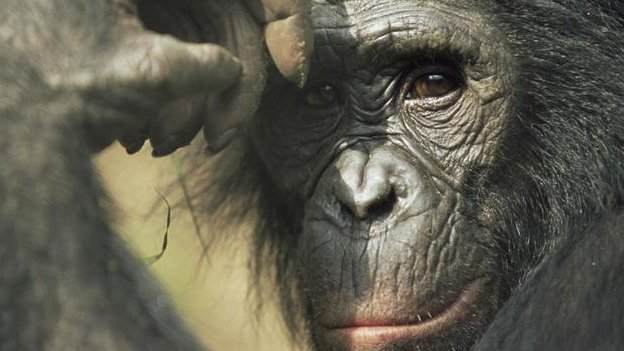
Yes, the first inklings, forerunners, of man.  The great apes are wonderful creatures, full of intelligence, energy, and drive.  But it is frustrating to interact with them.  They are so close and yet so far from having full interactive personalities.  They have teleological urges but they are only effective, for the most part, at the biological level.  Their social life is rudimentary and their spiritual awareness is diffuse and inarticulate.  They lack a symbolic order.  They can’t project ideals beyond the sensual.  They can’t respond to Me either.

“But they evolved?”

The transition to early man is both slow and sudden.  Remember what the first two years of a child’s life is like, and (then) imagine each day to be a century.  In a sense, nothing is happening.  One day looks much like the last, and there is no single great leap forward.

So imagine My excitement when the first protohumans arrived.  At first, you couldn’t tell them from animals but I could see their potential.  They didn’t have language but their sounds and marks had representative purposes.  They could connect one thing to another, one thought to another.  They could remember their past and replay it in their minds.  They slowly developed a sense of the future.

“Pray and I will tell you”

I started making a list of great spiritual leaders to pray about.  I thought the question would be, for example, What was God communicating to Martin Luther?  But, when I asked, I got a different answer.

Suppose you brought a guy in – say, Luther – and cut him up (dissected him, looked at the elements that make him up).  What would you find?

“Not just the single solitary individual, I suppose, but someone immersed in a tradition, institutions, and a culture.”

I act over the centuries in reference to individuals, but also movements, cultures, and the like.

“But only individuals receive communications.”

Just listen for the moment.  I interact with mankind, with the universe, in many different ways.  Do not assume that the only interaction is the same form of the interaction I have with you.  With some it is conversational, but with others it is by inspiration, by My spirit moving through them, infusing institutions and life-forms, cultures, cultural forms, art, music, dance, symbolism, ideational systems, thought forms …

So, looking at each cultural form, I should be able to figure out how it reflects You?”

The starting point is not the cultural forms and asking “What kind of God or transcendent order does that imply or suggest?” but start with Me and ask “What am I doing with that culture, individual, art, art form, or whatever.  What is it to Me?”  Pray and I will tell you.