If It Weren’t For the Honor of the Thing …

I remembered Abraham Lincoln’s story about the man who was tarred and feathered and run out of town on a rail.  “If it weren’t for the honor of the thing,” the man said, “I would rather have walked.”  And I had seen the war movies, “You will have the honor of leading the assault.”  Some honors aren’t worth it.

I did feel the honor.  God was about to put His seal on this role for me, a role more suitable for a real Elijah.  I felt a swell of pride, as I was being told this, and immediately the line went dead.  Ego had broken the connection.


I Draw Man Forward . . .


What I had been told about Creation still bothered me and I was relieved when God started talking about the process of evolution.

“Lord, do You have to will creatures to evolve into homo sapiens or does it just happen by natural processes?”

That’s not a well-conceived question.  It rests on a false dichotomy.  Remember that nature is itself teleological, except it is much more complicated than that apparently simple statement.  I provide—I am—the telos or purpose, and I follow the telos as well.  However, I draw man forward to greater development in the very process of interacting with men (people).  At the time of early man, I am not yet sure what is missing.  I am not fully developed Myself yet, since I have not encountered beings who can call forth My full latent nature.  For the moment, call it a dialectical evolution responding to My need for development.

Here and elsewhere, “man” has the older sense inclusive of both women and men.

High Middle Ages and Happiness

There was a historical period known as the High Middle Ages — a fitting term for the stage of life at which Abigail and I found one another.  I hoped we would have at least ten good years together before the hazards of life caught up with us.  As of January 20, it has been twenty-two years.  Recently, she reported – not just to me but to her acupuncturist and her favorite horse – that she was “happy.”  For her, it was an embarrassing confession.  Scholars and intellectuals NEVER say they are happy.  They are too smart and sophisticated for that.  And too deep.  Weighty thinkers are supposed to be full of existential dread and infinite angst.  She reports that, because her European mother was “happy” as a child, she was thought to be not too bright.  Charles de Gaulle was once asked by a reporter, “Are you happy?”  “Are you nuts?” the French leader responded.  (It sounded better in French.)  But my profound, brilliant, cosmopolitan wife reports herself as “happy.”  I was pleased for her, of course, but even more for what it seemed to say about me.  Although I am a rather lumpish husband, notorious for having been a poor date, who takes her nowhere and does nothing, and yet – thank God! – she is “happy.”  My Dad advised me way back when, “Make her happy and you’ll be happy.”  Thank you, Dad.

Tell My Story As I Tell It To You


“So I should read the scriptures of the major religions?”

Yes, I want you to read the early spiritual history of mankind.  I will lead you to which readings.  I would like you to pray as you read them and take notes as directed.

I grew up at a time when “man” and “mankind” referred to both men and women, and God spoke to me in my own vernacular.

“Lord, You said I was to tell Your story ‘from the inside out.’  But reading the scriptures is ‘from the outside in.’”

Yes, tell My story as I tell it to you.  The only purpose for reading is to give you reference points for understanding My story.


Alasdair MacIntyre RIP

My friend, Alasdair MacIntyre, died this year. I call him my friend, although our paths crossed only intermittently. I first met him, when he was speaking in Boulder. “I may be a member of the Moral Majority,” he told me. Well, I was too, in a similarly modulated way. Later, when After Virtue appeared on the cover of TIME magazine, I asked him whether he had been prepared for the celebrity. “Not at all,” he said, “not in the least.” But he took it in stride and it served him and his world audience well.

Alasdair owed me nothing. We had never been colleagues or in any other special relationship. Nevertheless, he offered a generous endorsement whenever I asked for it. A few years ago, as he was growing older, lest I leave something important unsaid, I send him a note thanking him for his many kindnesses.

He wrote back that he owed the greater debt to me. For what? For having shared my God experience with him. Though defending one set of philosophical battlements after another over the years, he came, before the end, to have an open soul. God bless him!

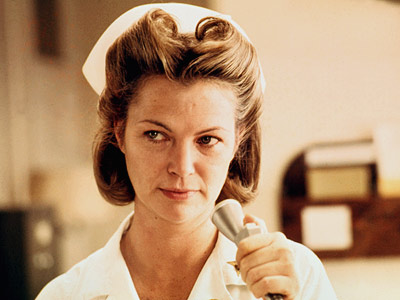
Mano-a-mano with Nurse Ratched

The procedure went smoothly and I was able to watch the monitor as the surgeon snaked a catheter up from my groin to a major coronary artery.  The blocked place was easy to spot, and he inserted a stent to keep it open.

Opening an artery is a very serious matter.  If it starts bleeding, it can be life-threatening.  The patient has to lie flat on his back and absolutely still for twenty-four hours.  Nurses at my first hospital had been wonderful, but here I was attended by a woman who was Nurse Ratched without the charm.  She seemed to resent the fact that patients needed her help.  Finding it difficult to manage the bedpan flat on my back, I asked for her help.  She acted as if it were a dirty-minded request and responded by threatening me, “If you can’t manage the bedpan, we will catheterize you.”  Finally, I did manage, and the twenty-four hours were up.

Another patient had told me that closing up the artery can be painful as well as dangerous.

“Who is to perform this delicate operation?”

Nurse Ratched gave me the grim news:  young Mr. Sizzorhands, the very technician whose previous efforts to hurt me had been foiled, would now have a really good shot at it.  I told her I wanted someone else to do it.  She made it a battle of wills.  “He is the only technician available.”

“I am not going to let that guy lay another hand on me.”

We went back and forth.  Finally I said, “Let me speak to the doctor.”

She said she would see what she could do and, after a time, she returned with a young Asian-American attendant.  He had the hands of an angel.  I didn’t feel a thing.


A Time of Mending is Needed


Mankind does not live in a period for a Great Prophet.  There can be no new Moses or other Deliverer.  There can at best be Elijahs—prophets and seers—people who explain My story in a form that can be understood by this age.

A time of mending is needed, but the nature of the world today prevents the presentation of a single, unitary vision.  The best I can do is to share visions with particular individuals and let them articulate these visions in their own voices.

Yes and No

I read more of Conversations with God on a long coast-to-coast flight, occasionally pausing to pray about this or that, and writing the brief answer in the margins.  I asked about the following statements Walsch attributes to God.

“You are living your life the way you are living your life, and I have no preference in the matter.”

Wrong.

“This is the grand illusion in which you have engaged:  that God cares one way or the other what you do.”

Wrong.

“You are in a partnership with God.  We share an eternal covenant.  My promising to you is to always give you what you ask.”

Yes.

“The promise of God is that you are His son.  Her offspring.  Its likeness.  His equal.”

Yes and No.  Partners, yes.  Both necessary, yes.  The same in scope and power, no.

“I tell you this:  all you see in your world is the outcome of your idea about it.”

Too simple, but the overall direction is correct.

“The person who has the ‘faith to move mountains,’ and dies six weeks later, has moved mountains for six weeks.”

He has stated it all too simply and so the answer is off-center.

“I tell you this:  every experience you have, I have.”

Yes.

What He Said, I Said

God had explained that He is a Person, but not a human being.  “But Jesus is.”

Yes.

“Then how can it be right to say that Jesus is identical with God, that he is God?  Two beings cannot be identical if one is human and one is not, one is mortal and the other is not.”

This notion of identity is not helpful here.  Jesus’ whole heart and soul and mind were one hundred percent infused with Me.  What he said, I said—just as what you are writing now is what I am telling you.  And some of your thoughts are put there by Me, which means they are Mine, because they are put there by an indwelling of Me in you, a partial merge, if you will.  This is not just inspiration.  When I enter something, I really enter it—become infused—”intermingled” is too weak a word because the elements are no longer separately identifiable.

Well, all that was a lot to take in.  I would have to “let it percolate” as Miss Finley, my high-school Latin teacher, used to say.

Why Do Bad Things Happen to Good People?

I have been behind – or barely keeping up – on several important fronts. Here is the brief explanation I sent a friend some weeks ago, shortly after Abigail broke a hip, minutes before we were to present papers at the NE AAR:

I have been overwhelmed since the first May 2 mishap. We had a second episode, after being released from Acute Rehab, when, while at home doing rehab with occasional helpers, Abigail’s was extremely weak. They measured her blood pressure: 60/40! I have never heard of so low a blood pressure. There was another drama, which I will spare you, that delayed our calling 911, but when we did, they could barely believe that she was sitting up, able to talk to them. They immediately put in two pints of blood and another pint a day or two later. They were not sure of the source of the bleeding but it turned out to be a bleeding ulcer. They cauterized it. That didn’t quite work, so they did it again. She is now at home and has resumed rehab exercises that may last for many weeks. For me, the impact has been as much emotional as well as being somewhat run ragged. When I fell in love, I was aware that I had a new vulnerability. I have learned to live alone – after a divorce, that can be a relief – but, having found my true love, it would be immeasurably harder to go on alone. That concern has taken the stuffing out of me.

As I now reflect on events, I recall Abigail’s asking the nurses, in a stream of medical queries, “tell me, why do bad things happen to good people?” They smiled and shook their heads. Years ago, she had asked her friend, the Jewish philosopher Michael Wyschogrod. His answer: “Our people on working on it and hope to have an answer soon.” Although, in God: An Autobiography and in Radically Personal, I find clues, this is and remains the unanswerable question.

__________________________________________
Explore more reflections in God: An Autobiography and Radically Personal